My love for wellness-centered design began long before it became a trend on Netflix, HGTV, or discussed in psychological research. I was around eight years old the first time I rearranged my bedroom with intention. With tiny legs pushing oversized furniture across the floor as if the room itself asked to be reshaped. I wanted my space to feel just right in all the ways it could. I smoothed my sheets until they felt like they belonged there, adjusted the lighting until the room seemed to exhale. I would rearrange things and then stand back to sense when the energy felt just as I wanted it to feel. The space felt aligned in energy, and the just-right feeling was found as my mind cleared and my body softened.
Those early experiments in creating “ahhh” for my surroundings became the foundation for what would eventually turn into my niche as a licensed counselor and wellness space designer.
As the years went by, various experiences moved me. Military life, then college transitions with relocations, and in each change, an opportunity for reinvention. Packing and unpacking my world countless times. Every move revealed the same truth. Energy is within us and within our space and in everything around us. The feeling of “things” can be felt, and having more things than we need or many things out of order never feels good. Clutter in corners, desk drawers so full that they cannot open, or bundles of tangled cords with no identity of their own can leave a trace of dread felt somatically in the body. On the contrary, a trip to the donation store, or a day of organizing something from intention into just the right shape and design, can bring on a feeling of lightness and clarity from within.
This awareness nudged me deeper. Through my education and training in psychology and counseling, and through my personal evolution and awakening, I came to understand that our environments are vital to our well-being. Every space we enter brings information for us to notice as we learn how to deepen our connection with our spaces and with ourselves. How color affects our mood. Texture influences through our senses. How the intentional placement of things can create a feeling of instant regulation. Whether we realize it or not, the spaces we inhabit become active participants in our emotional health and wellness.
This is the cornerstone of wellness design. Not just for looks from a surface approach, but designed from intention and intuition as a therapeutic tool. Putting together a well-considered space can regulate your nervous system the same way a deep breathing practice can. It can lower stress hormones, soothe anxiety, support focus, improve sleep, and, surprisingly, even spark increased creativity and productivity. I write this as I sit in my oversized rainbow swing, on my porch, in the winter sunlight with cool air, and watching a prism make a light show for me in the light breeze.
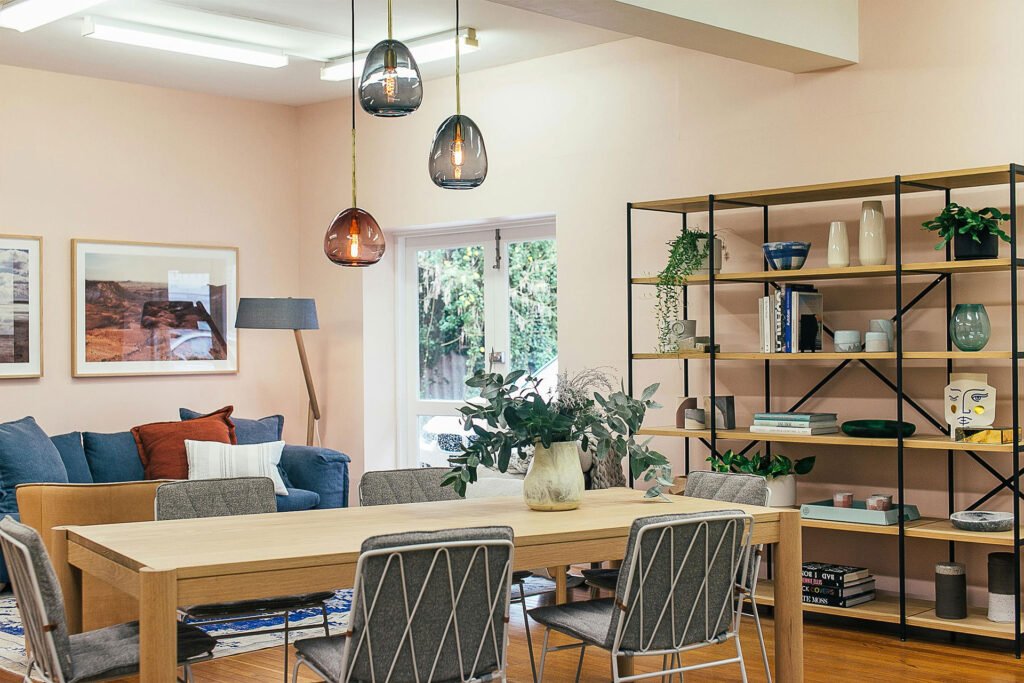
Now back to some first-hand research. In my counseling practice, I’ve seen countless visitors coming in for therapy sessions to find the healing powers of the space within the walls, beginning much of the healing work for us. Coming through the doors into our waiting area, being welcomed by the soothing water sounds of the stone fountain, plants set just right with green and blue hues of warmth and comfort. The table lamps are set with welcoming colored shades, and soft pillows placed on side chairs to greet them while they wait for their appointment. Their shoulders drop as their breathing finds rhythm in this sacred and cared for space. Their emotional openness finding them after a day of traffic and lines at the coffee shop. Coming through the intentional hallway, with tea, chocolate, and a couch awaiting them to unfold their emotions onto. They often said, “It just feels good in here,” and without needing to understand why, we were already off to a head start on our treatment goals. The nervous system responds to the environment immediately, time and time again, showing us that we can design our own wellness.
A strong foundation of wellness design involves trusting your intuition and tuning into the somatic intelligence you carry. Your body is the most honest design consultant you’ll ever meet. Pay attention to how you feel in a space. Does your chest tighten? Do you suddenly feel rushed or unsettled? Does your breath deepen? Does the room feel expansive or suffocating? What do you do with a busy home or office space with others around, children, or pets mucking up your mojo for the ahh wellness design? Start with a corner, even part of a room, a shelf, a table, make something just yours, and practice designing from a small and manageable approach to practice your own internal design vision. Potentially, the twinkly lights and sweet little plant placements and ridding the space of unneeded items will inspire your person to align the rest of your space when they feel the energy and space align over time.
Start by deeply listening to what your body is speaking to you. Sometimes our bodies are better than our minds at connecting with our intuition. Walk through each space you inhabit and notice your reactions. Then, clear the energetic noise: pick up, sort, shift, reorganize, and remove the items that feel unnecessary or heavy.
Next, observe the areas where you breathe easier, the corners where sunlight lingers, the textures that relax your senses, the colors that support your mood, and the lighting that feels restorative and calming. These observations become your blueprint. They reveal what your nervous system wants more of and what it’s asking you to let go.
From there, wellness design becomes a collaboration between your intuition and your psychology, a meeting point between what you know and what your body remembers. It isn’t about perfection. It isn’t about curated aesthetic trends. It’s about energetic alignment. It’s about creating harmony between your external world and your internal world.
Wellness design supports clarity, emotional regulation, daily routines, rest, relationships, and creativity. It becomes a living extension of your healing and your forward vision. When your environment is aligned with who you are becoming, you move through life differently, more grounded, more spacious, more connected to yourself.
Ultimately, you’re building spaces that help you exhale. Places that respond to your nervous system with steadiness. With surroundings that reflect your dreams, your energy, and your emotional wellness.
Your space has energy and powerful transformative potential.
It’s part of your nervous system.
It’s part of your psychological health.
It’s part of your healing journey.
With Gratitude, Everything Changes
Always,
Jaclyn Fortier, LCMHC
Founder @ CCWA
www.carolinacounselingwellness.com
www.jaclynfortier.com